Quick Intro
I’m adding a quick intro because I think it should be here. Spine-leaf network fabrics have already become a mainstream way to build data center networks, so I decided to create a series of notes to streamline my understanding and ensure that I can use these notes as a “teach me like I’m five” guide in the future.
I’ll be using the simplest approach with a very typical setup trying to avoid non-typical corner cases unless it is something necessary to implement.
I’m not going to cover the theory part since it has been covered in dozens of blog posts on the internet. My personal favorite is the Cisco Live presentations delivered by Lukas Krattiger.
Since my personal experience is also based on Cisco products, I’ll be using Cisco devices in my lab environment
The Network Topology
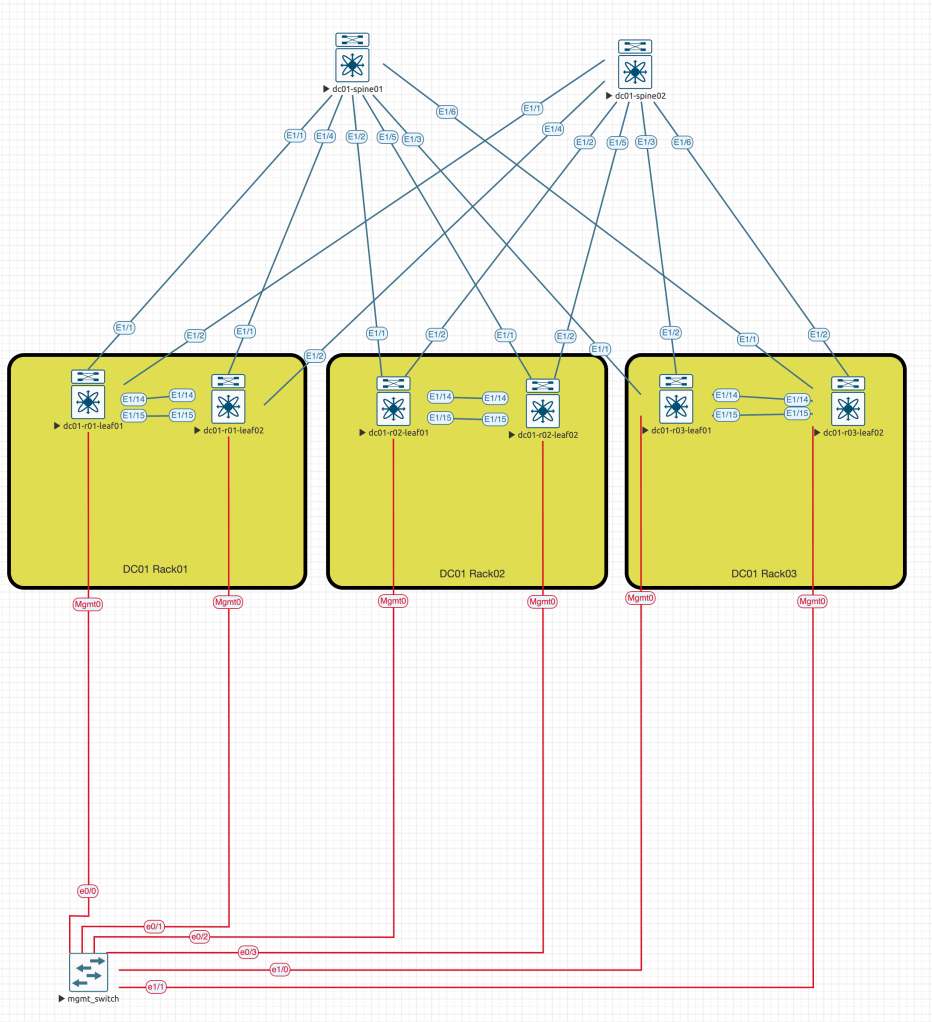
The Topology has 3 pairs of Nexus switches and the pair of Spine switches interconnecting them.
Also, I’m going to use a dedicated management network for the vPC keep-alive links.
IP addressing schema:
| Network | Prefix |
| Underlay Loopbacks | 10.255.255.0/24 |
| Overlay Loopbacks | 10.255.254.0/24 |
| Underlay Interconnects | 172.16.1.0/24 |
| Tenant Interconnects | 172.16.2.0/24 |
| Tenant Networks | 10.10.0.0/16 |
| MGMT Network | 192.168.100.0/24 |
Later, I’ll add to the diagram endpoints for different Tenants, DC Edge devices, firewalls and potentially Second DC
 Yet another Blog
Leave a reply to Building BGP EVPN VXLAN datacenter fabric – Part 3 (Underlay) – Yet another Blog Cancel reply